Packaging is the part of a food business that customers touch last, and regulators look at it from several angles. The container has to be safe for food. The label must include the right information in both official languages. Some plastics are restricted outright. Some businesses have reporting and recycling duties. And any environmental claim printed on the box has to hold up. No single law covers all of this, which makes it easy to miss a piece. This guide walks you through the main food packaging regulations in Canada, who each one is aimed at, what to check, and what is changing. It is general information, not legal advice, and rules change, so confirm the details that apply to your business with the regulator or a qualified advisor.
The Main Rules for Food Packaging in Canada
1. Packaging Must Be Safe for Food Contact
The foundation is Health Canada‘s packaging safety rule. Division 23 of the Food and Drug Regulations regulates the safety of all materials used to package food, and section B.23.001 prohibits selling food in a package that may transfer any substance to the food that could be harmful to the person eating it. There is no list of approved packaging ingredients. Instead, the responsibility sits with the food seller—which may include the manufacturer or distributor—to ensure the packaging is safe and compliant.
Two practical points follow. First, Health Canada offers voluntary premarket assessments of packaging materials, and a favourable result is called a letter of no objection. These letters provide useful assurance, but they are not a legal approval, and they do not remove the food seller’s responsibility. Second, recycled plastics used for food packaging are subject to the same chemical safety rules as virgin plastics.
If you operate a federally registered food establishment, the Canadian Food Inspection Agency no longer requires packaging materials to be pre-registered, but you remain responsible for using packaging that is safe and suitable for its intended use.
2. Labelling Rules for Prepackaged Food
If you sell prepackaged food, the label is tightly regulated. The Canadian Food Inspection Agency publishes a labelling requirements checklist covering the core rules that apply to all foods. In summary, it covers:
- Common name on the principal display panel.
- Net quantity in metric units on the principal display panel.
- List of ingredients and allergens, in descending order of weight, with priority allergens, gluten, and added sulphites declared as required.
- Name and principal place of business.
- Date markings. A “best before” date is generally required for foods with a durable life of 90 days or less, subject to exemptions. For food packaged at the retail location where it is sold, date-marking requirements differ; businesses may generally use either a “packaged on” date accompanied by durable-life information or a “best before” date.
- Nutrition Facts table, unless an exemption applies.
- Bilingual labelling. Mandatory information must generally appear in both English and French, with exemptions for certain products.
The Canadian Food Inspection Agency also states that all label information must be truthful and not misleading, and that additional federal and provincial rules may apply.
A recent change deserves attention. The front-of-package nutrition symbol became mandatory by January 1, 2026, and the Canadian Food Inspection Agency states it will not exercise enforcement discretion after that date. It applies to prepackaged foods that meet or exceed set thresholds for saturated fat, sugars, or sodium, subject to exemptions and prohibitions, and it must appear on the principal display panel in a prescribed format. The checklist is a self-assessment tool and not a legal document, so use the full regulations and the agency’s Industry Labelling Tool for your product.
3. Single-Use Plastics Restrictions
The federal Single-use Plastics Prohibition Regulations prohibit the manufacture, import, and sale of certain single-use plastic items, including foodservice ware made from or containing certain problematic plastics. These include polystyrene foam, PVC, oxo-degradable plastics, and black plastic made with carbon black. For restaurants, caterers, and food retailers, this affects takeout containers, trays, and similar items.
The legal status matters. In January 2026, the Federal Court of Appeal upheld the legal basis for the regulations, and in October 2026 the Supreme Court of Canada agreed to hear an appeal. The regulations remain in force while the appeal proceeds. Ask your supplier to confirm that any foodservice ware you buy complies, and check how the rules apply to the specific product.
4. Federal Plastics Registry Reporting
Some businesses have an annual reporting duty. Environment and Climate Change Canada‘s Federal Plastics Registry requires producers of plastic products to report each year on the plastics they manufacture, import, or place on the market in Canada, including plastic packaging. A producer can include brand owners, importers, manufacturers, retailers, and marketplace sellers. Reports cover packaging categories, resin type and source, and quantities in kilograms for both empty and filled packaging placed on the market.
Small producers that place less than 1,000 kg of plastic products or packaging on the market in a calendar year are exempt. A producer may appoint another person, such as a producer responsibility organization, to report on its behalf, but the producer remains ultimately responsible for the report and its accuracy. Reports are due on a phased schedule through 2027. Failing to report, or reporting late or inaccurately, can lead to penalties under the Canadian Environmental Protection Act, 1999. Check whether your business is a producer for this purpose, and whether your supplier or a producer responsibility organization is reporting for you.
5. Provincial Recycling and Producer Responsibility Rules
Provincial and territorial approaches to extended producer responsibility vary. These programs make producers responsible for managing packaging at the end of its life, and Environment and Climate Change Canada notes that reporting requirements vary across the country. The federal registry does not replace provincial reporting.
Ontario is a useful example. Under the Blue Box Regulation, the Resource Productivity and Recovery Authority explains that a person is a producer if they supply packaging, paper products, or packaging-like products made of paper, glass, metal, or plastic to consumers in Ontario. Producers must register within 30 days of supplying obligated materials, unless exempt, and submit an annual supply report and pay program fees. Exemptions exist, including one based on gross annual revenue (under $2,000,000 in annual Ontario revenue, per the regulator’s guidance) and one based on the weight of material supplied. A food business that hands takeout and delivery packaging to Ontario consumers should check whether it is a producer, and which producer responsibility organization may be involved. Rules differ in other provinces, so check the rules where you operate.
6. Environmental Claims on Packaging
Printing “eco-friendly,” “compostable,” or “recyclable” on a container is a marketing claim, and the Competition Bureau enforces the rules. The Competition Bureau explains that environmental claims, like any other marketing claim, must not be false or misleading in a material respect, and that it looks at the overall impression a claim creates as well as its literal words. It also explains that claims about a product’s performance and environmental benefits must be based on adequate and proper testing carried out before the claim is made.
The Competition Bureau offers six principles that are useful for packaging: be truthful; test product benefit and performance claims properly; be specific about any comparison; avoid exaggeration; be clear and specific, not vague; and support claims about the future with a clear plan. It specifically warns that a vague term such as “eco-friendly” can suggest a benefit across a product’s entire life that may not be true. It also notes that a limited, factual claim, such as a stated percentage of recycled content, does not need testing, but still must not be misleading. The rules for claims about a business’s environmental benefits were amended in 2026, so check the Competition Bureau’s current guidance before making claims about your business as a whole.
In practice, only call packaging “compostable” if you can substantiate the claim, including any relevant certification, and be clear about the conditions it needs. Do not call it “biodegradable” without saying what conditions are required for it to break down. And remember that whether something can be recycled or composted depends on the local program, so say what is true where your customers are.
7. What Is Changing: A Proposed Mandatory Framework
Health Canada is consulting on a significant change. Today, premarket packaging assessment is voluntary. Health Canada has consulted on a proposal to move to a mandatory notification system for food contact materials and food service ware, with notified information cross-referenced against a public knowledge base of evaluation outcomes. Who would be responsible for notifying—manufacturers, brand owners, importers, or retailers—is still being considered. A second consultation was expected from November 2026 to January 2027, and any phase-in would take about five years.
This is a proposal only. No mandatory requirements have been adopted. Food sellers remain generally responsible for the safety of their packaging under existing law. It is worth following the consultations and, in the meantime, asking your suppliers what information they hold about the composition of their packaging.
A Quick Map of the Rules
| Rule | Who it mainly affects | What to check |
| Food contact safety (Division 23, B.23.001) | Every food seller | That your packaging is safe for its intended use, and what documentation your supplier has |
| Labelling rules and the front-of-package symbol | Sellers of prepackaged food | Required label elements, bilingual text, date markings, and whether the nutrition symbol applies |
| Single-use plastics restrictions | Businesses using foodservice ware | That containers and trays comply, including any foam, PVC, or black plastic |
| Federal Plastics Registry | Producers of plastic packaging or products, at or above 1,000 kg a year | Whether you are a producer, and who reports for you |
| Provincial recycling programs | Businesses supplying packaging to consumers | Registration, reporting, and exemptions in your province |
| Environmental claims | Anyone printing or advertising green claims | That each claim is specific, true, and backed up |
Questions to Ask Your Packaging Supplier
A good supplier can answer these directly.
- Is this packaging suitable for food contact, and what documentation can you provide? Ask whether a letter of no objection or similar information exists for the material.
- What is it made of? Ask for the material and resin type, and whether it contains foam, PVC, or black plastic.
- Does it meet Canada’s single-use plastics rules? Ask them to confirm for your specific product.
- Is it certified compostable, and under what conditions? Ask for the certification, and what facilities it requires.
- What can I truthfully say about it? Ask what claims the supplier can substantiate, so you do not repeat a claim you cannot support.
- Who handles reporting duties? Ask whether the supplier reports plastic quantities or provincial obligations, and what information they need from you.
- What are the minimum orders and volume pricing? Consider compliance and cost together.
Choose Compliant Packaging at Bulk-Friendly Pricing, Only at Planetize Packaging
Food packaging regulations in Canada cover several areas at once: food-contact safety, labelling, restrictions on certain plastics, reporting and recycling duties, and the claims you make on the box. The businesses that handle it best ask questions early, keep their supplier documentation, and say only what they can back up.
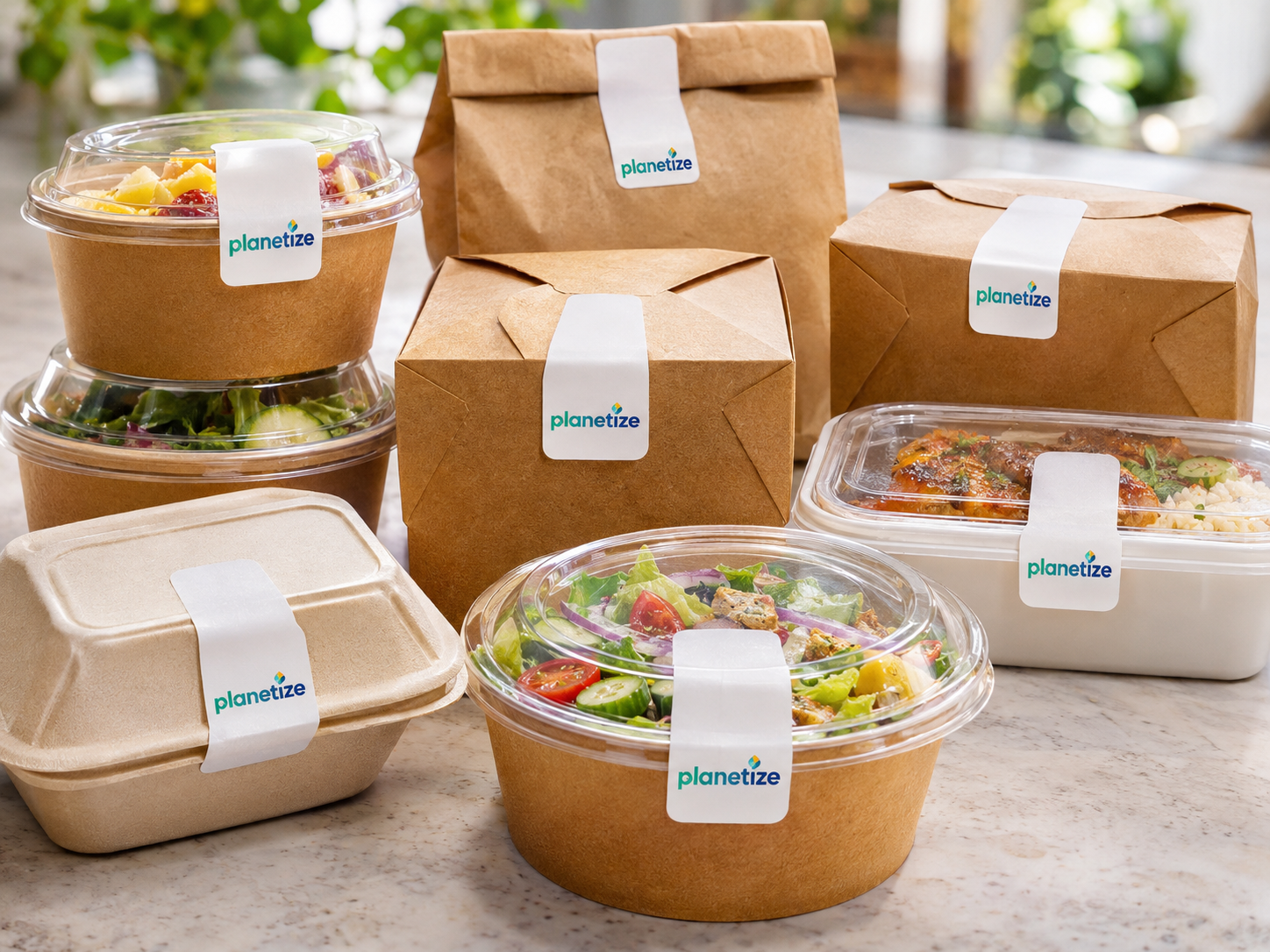
At Planetize Packaging, we supply sustainable packaging solutions for restaurants, caterers, and hospitality groups, with bulk-friendly pricing so you can stock what you need at a cost that works at volume. We are happy to talk through the materials you are considering and the documentation worth requesting, so you can choose packaging with confidence. Contact us to discuss what your business needs.
Frequently Asked Questions
What regulations apply to food packaging in Canada?
Several apply at once. Packaging must be safe for food contact under Health Canada‘s rules; prepackaged food must meet the Canadian Food Inspection Agency‘s labelling requirements; certain single-use plastics are restricted; some businesses must report plastics to the federal registry and meet provincial recycling rules; and the Competition Bureau oversees environmental claims.
Does food packaging need to be approved in Canada?
There is no mandatory premarket approval today. The food seller is responsible for ensuring packaging is safe for food contact. Health Canada offers voluntary assessments that result in a letter of no objection, which is not a legal approval. Health Canada has consulted on a proposed mandatory notification system, but has not adopted any mandatory requirements.
Do food labels have to be bilingual in Canada?
Generally, yes. Mandatory label information must appear in both English and French, with exemptions for certain products. Check the Canadian Food Inspection Agency‘s guidance for your product.
Can I call my packaging compostable or eco-friendly?
Only if you can back it up. The Competition Bureau expects environmental claims to be truthful, specific, and not exaggerated, and certain product claims must be based on adequate and proper testing. Use “compostable” only when you can substantiate the claim and state the conditions it needs, and avoid vague terms such as “eco-friendly.”
Are black plastic or foam takeout containers allowed in Canada?
Foodservice ware made from or containing foam, PVC, oxo-degradable plastics, or black plastic made with carbon black is restricted under the federal Single-use Plastics Prohibition Regulations. The regulations remain in force while an appeal is heard at the Supreme Court of Canada, so confirm compliance with your supplier.